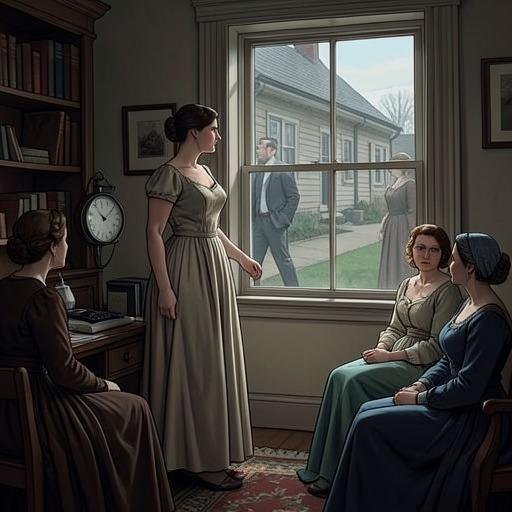
Adela’s affair with Pepe el Romano
The House of Bernarda AlbaAdela’s affair with Pepe el Romano is the concealed relationship that turns the household’s strict rules into a crisis. While Pepe is publicly courting Angustias, Adela is resolved to have him for herself; the growing suspicion around his nighttime visits deepens the conflict among the sisters and exposes the unequal sexual and reputational rules governing their lives. The relationship ends in tragedy when Adela, led to believe Pepe is dead, takes her own life, and Bernarda responds by imposing silence and a public account designed to preserve family honor.
A secret beneath the household’s rules
In Act Two, the household’s attention first gathers around the hours Pepe leaves Angustias’s window. Amelia says he departed at half-past one, while Poncia has also heard someone leaving at about four. These discrepancies prompt curiosity and unease, even as the sisters’ questions reveal their inexperience with sexual matters. Adela is unwell and increasingly tense with Martirio; Poncia recognizes her fascination with Pepe and advises her to put aside her desires. Adela rejects the advice angrily, insisting that no one can stop her.
The distinction between Pepe’s public courtship and Adela’s secret attachment becomes harder to maintain as the household watches and listens. Martirio and Amelia discuss a presence in the stable-yard in the early hours, while the family’s rooms, windows, and yard become places where absence and movement are scrutinized. The evidence establishes Adela’s determination and the sisters’ suspicions, but does not describe the beginning of the relationship or the terms on which Pepe conducts it.
Exposure and rivalry
The stolen portrait of Pepe, taken from beneath Angustias’s pillow, gives the household’s suspicions a visible focus. Bernarda orders Poncia to search the rooms, and the portrait is found between the sheets of Martirio’s bed. The discovery provokes accusations and bitterness among the young women; it also brings into the open the tension surrounding Pepe, although the portrait itself is not evidence of Adela’s affair.
Left together after the disturbance, Adela and Martirio confront one another. Martirio threatens to expose Adela’s relationship with Pepe, and Adela answers that he will be hers. Later, Martirio calls Adela from the yard after she has slipped out of the room. Adela appears with dishevelled hair and straw on her petticoat, and in their argument she boasts of her relationship with Pepe. Martirio then admits that she loves him too. The revelation makes their conflict explicitly about a shared attachment to a man already associated with Angustias, while Bernarda remains resistant to Poncia’s warnings that something serious is happening.
The public mirror of private shame
The affair unfolds against a community that punishes women’s sexual conduct while tolerating men’s freedom. During the disturbance in the street, the household hears of Librada’s unmarried daughter, who has given birth and killed the child in an attempt to hide her shame. Dogs uncover the baby, and villagers drag the woman through the street as men approach from the paths and olive-groves. Bernarda calls for the woman to be killed; Adela cries out against the killing and clutches her stomach. The scene places her private relationship beside the village’s public violence against a woman who has broken its sexual code.
Lorca’s commentary situates these conflicts within the traditional social order of contemporary Spain. Bernarda enforces women’s domestic subordination and worries that sexual conduct will damage the family’s name; the play’s commentary also emphasizes the contrast between the condemnation of women and the greater acceptance of men’s sexual behavior. The account of the 1870 Penal Code, whose provision allowing a husband to cleanse his honor with blood was not repealed until 1963, provides historical context for the violence of honor codes, rather than a claim that the play’s events directly enact that law.
The final confrontation and its aftermath
On the final night, María Josefa tells Martirio that Pepe will destroy the young women of the household. After persuading the old woman to return to her room, Martirio calls Adela from the yard. Their confrontation confirms the affair and Martirio’s own love for Pepe. Bernarda learns from Martirio that Adela has been with him in the stable and rushes out in pursuit. A shot is heard. Martirio first claims that Pepe is dead, but then reveals that he escaped.
Adela runs into another room and locks the door. When it is opened, Poncia’s reaction and words make clear that Adela has hanged herself. Bernarda orders that the body be taken down and that everyone say her daughter died a virgin. She insists that no one speak and begins a new period of mourning, turning the private consequence of the affair into a family secret. The relationship therefore ends not in a public reckoning with the pressures that produced the tragedy, but in Bernarda’s attempt to control its meaning and protect the household’s reputation.